




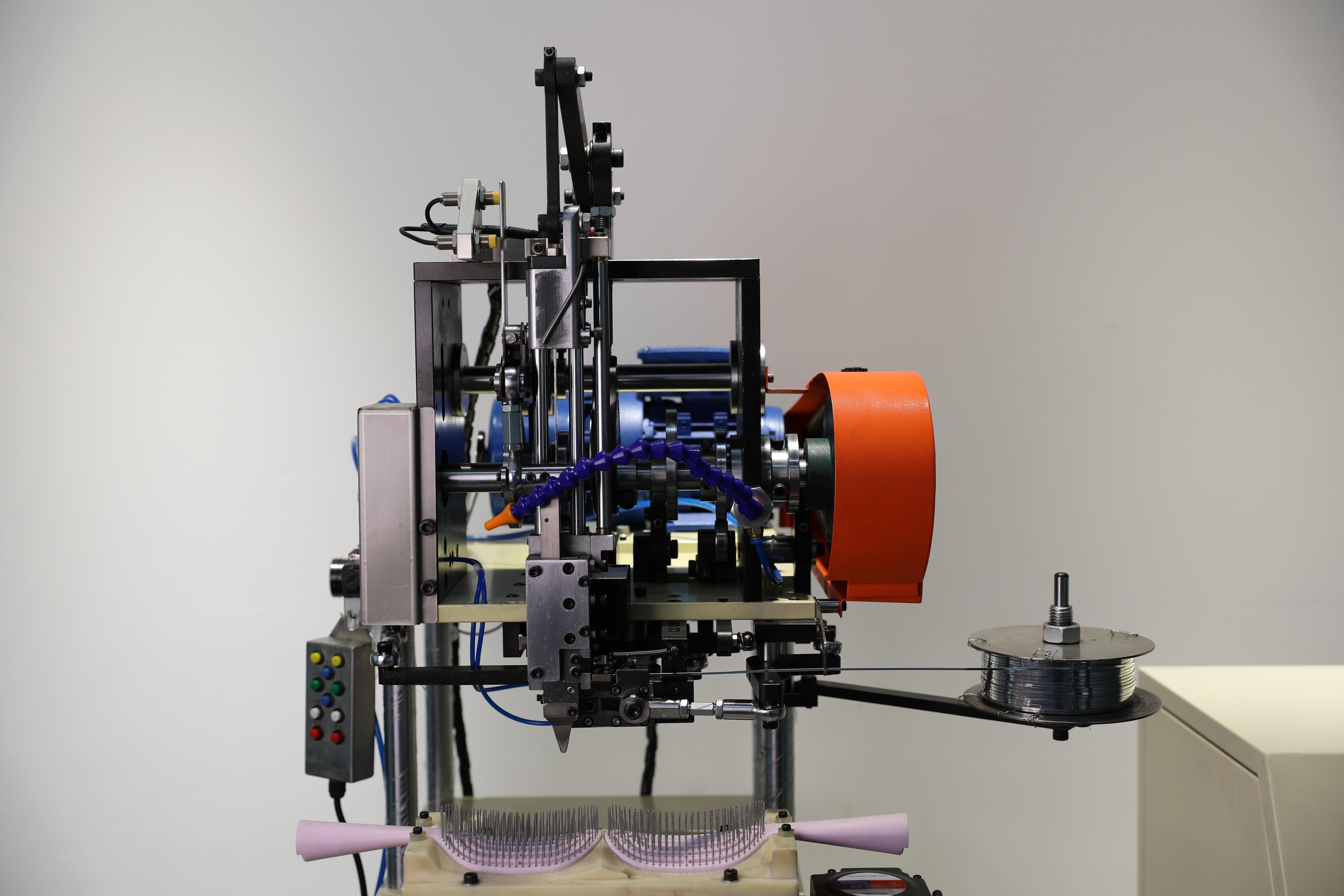
A Complete Guide to Purchasing Beauty Comb Making Machinery for Overseas Buyers: Look Beyond Price to Quality and Details
Beauty combs fall into the personal care and beauty category, with direct contact with human scalp and hair, thus imposing extremely high requirements on the precision, hygiene and compliance of production machinery. Different overseas markets, including Europe, the United States, Japan, South Korea and Southeast Asia, have formulated exclusive safety and environmental protection standards for such equipment and finished products. Overseas purchasers should never take the initial quotation as the sole decision-making basis; instead, they need to conduct a comprehensive inspection from five core dimensions: international compliance qualifications, production precision, material and craftsmanship, customization adaptability, and cross-border after-sales service.
1. International Compliance Qualifications: The Core of Customs Clearance and Market Access
Compliance qualification is the primary threshold for overseas procurement. Equipment without complete and valid compliance certificates will face risks such as customs detention, sales prohibition and heavy fines even if the price is extremely low. First, purchasers must verify that the machinery holds mandatory certifications for target markets, including CE certification (compulsory for the EU market), UL/ETL certification (for the North American market), and ISO9001 quality management system certification. For high-end beauty markets, equipment also needs to meet GMP hygiene standards to ensure no harmful substances are released and no dust pollution is generated during the production process.
In addition, suppliers are required to provide complete supporting documents, including equipment certificate of origin, quality inspection report, English operation manual and safety warning labels. All documents must be adapted to the language of the target market to avoid customs clearance delays and additional costs caused by incomplete or non-standard documents.
2. Production Precision and Finished Product Quality: Determine Product Competitiveness
The quality of beauty combs is directly determined by the performance of production machinery, and key indicators such as tooth density, tufting depth, rounded corner polishing and overall flatness directly affect user experience and product pricing. During procurement, purchasers should focus on the following core indicators: the error of equipment tufting precision shall be controlled within ±0.1mm to eliminate defects such as skewed teeth, falling off and burrs; the machine must be equipped with automatic polishing, buffing and chamfering functions to avoid sharp edges that may scratch the scalp; it supports quick mold change for multi-specification combs, adapting to the production of various products such as airbag combs, rib combs and children's combs; the operating noise of the equipment is ≤60dB, complying with environmental noise reduction requirements of overseas workshops.
It is highly recommended to require suppliers to provide trial production samples, conduct on-site testing of finished product qualification rate and defect rate, and firmly reject low-precision equipment with low prices but unstable quality, which will damage brand reputation and market share.
3. Material and Durability: Reduce Long-term Operation and Maintenance Costs
Most low-price beauty comb machinery on the market uses inferior steel and ordinary motors, which have short service life, high failure rate and extremely difficult cross-border maintenance. Overseas purchasers should give priority to equipment with a fuselage made of 304 stainless steel or thickened cold-rolled steel, which is rust-proof and corrosion-resistant, suitable for long-term high-frequency production. The core motor shall be a pure copper special motor for foreign trade, adaptable to different overseas voltages (110V/220V/380V), with stable operation and low energy consumption.
Wearing parts such as tufting needles and molds should be made of wear-resistant alloy materials to extend the replacement cycle, reduce the cost of overseas parts procurement and international transportation, and avoid production suspension caused by long-term waiting for parts replacement. In the long run, high-quality and durable equipment can greatly reduce comprehensive operation costs compared with cheap and inferior equipment.
4. Exclusive Foreign Trade Service: The Core Guarantee for Cross-border Procurement
For overseas purchasers, complete cross-border supporting services are far more important than a temporary low price, which directly determines whether the equipment can be put into operation smoothly and run stably for a long time. Key service items to be confirmed include: on-site installation and commissioning, and technical training for overseas technicians (in English or local language); clear 1-2 years of whole machine warranty, free wearing parts as gifts, and remote technical guidance during the warranty period, with overseas after-sales service outlets available for remote areas.
In addition, suppliers should provide wooden box vacuum packaging, which is moisture-proof, shock-proof and rust-proof, suitable for sea and air transportation; assist in handling export declaration and commodity inspection, provide complete customs clearance documents, and shorten the port arrival cycle; support small-batch trial orders and OEM/ODM customization services to adapt to the production capacity needs of different overseas customers.
Tags: